
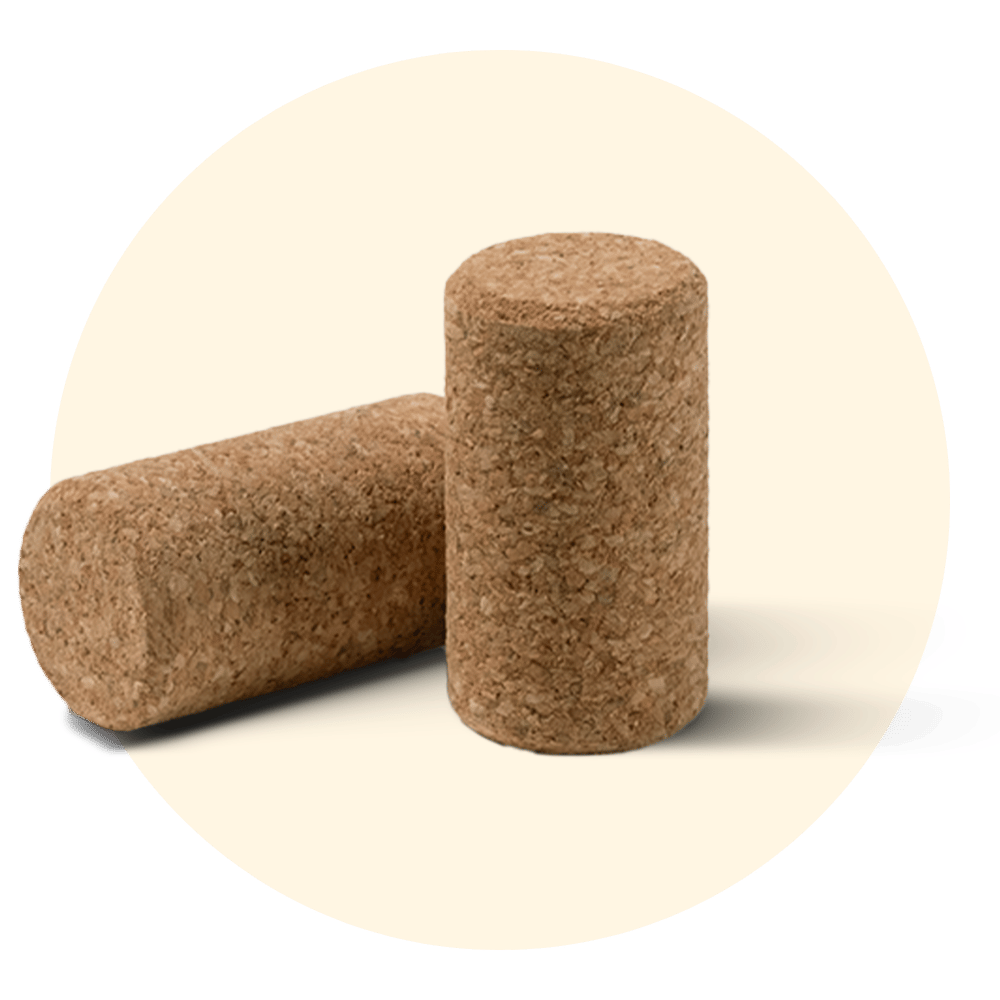
Symbioz® by Xpür is the most advanced and sustainable
technical cork stopper available. Made from cork granules and
a natural binder composed of 100% plant-based polyols, it is
specially designed for wines that require five to ten years of
bottle ageing.
This innovative cork is treated with the revolutionary Xpür®
technology, which uses supercritical fluid extraction to remove
TCA, ensuring enhanced sensory neutrality and a TCA level
at the detection limit of 0.3ng/L per unit. The Symbioz® by
Xpür closure is composed of approximately 98% natural cork
granules by volume and 82% by weight.
In addition to its superior quality, Symbioz® by Xpür offers exceptional structural stability, ensuring perfect sealing, which is essential for preserving wine quality over time. This makes it a first-class choice for winemakers who prioritise both performance and sustainability.
Also available with FSC® certification.
44 x 24 mm
49 x 24 mm
Up to 10 years
| Characteristics | Parameters | Specifications | |
|---|---|---|---|
| Dimensions |
Length
Diameter
Ovalisation
|
± 1,0 mm
± 0,4 mm
≤ 0,3 mm
|
|
| Physical and chemical properties |
Moisture
Apparent volume mass
Extraction force
Peroxide content
Dust content
TCA (2,4,6 - Trichloroanisole)
|
2 - 8%
240 - 320 kg/m³
15 - 45 daN
≤ 0,1 mg/stopper
≤ 2,0 mg/stopper
≤ 0,3 ng/l**
|
|
| Permeability** |
OIR (oxygen release up to 6 months)
OTR (oxygen transfer after 6 months)
|
44 x 24 mm
1,1 mg O₂
0,07 mg O₂/year
|
49 x 24 mm
1,0 mg O₂
0,04 mg O₂/year
|
* The colors shown in the various washing options are for illustrative purposes only and may not be accurately reproduced in the photographs. Slight variations may occur depending on the type of stopper selected. Portocork cannot be held responsible for these minor variations. We therefore recommend that you take them into consideration when making your final product selection.
** Releaseable TCA content equal to or less than the dection limit of 0.3 ng/l; analysis carried out in accordance with ISO 20752
*** Oxygen transmission rate determined as described in P.Lopes; C.Saucier; Y.Glories; J.Agric. Food Chem. 2005, 53, 6967-6973.